Overview
Random partitions of space underlie some of the most successful nonparametric methods in machine learning, including random forests and random feature kernel approximations. My research connects these algorithms to the classical theory of random tessellations in stochastic geometry, enabling rigorous analysis and principled generalization of these methods.
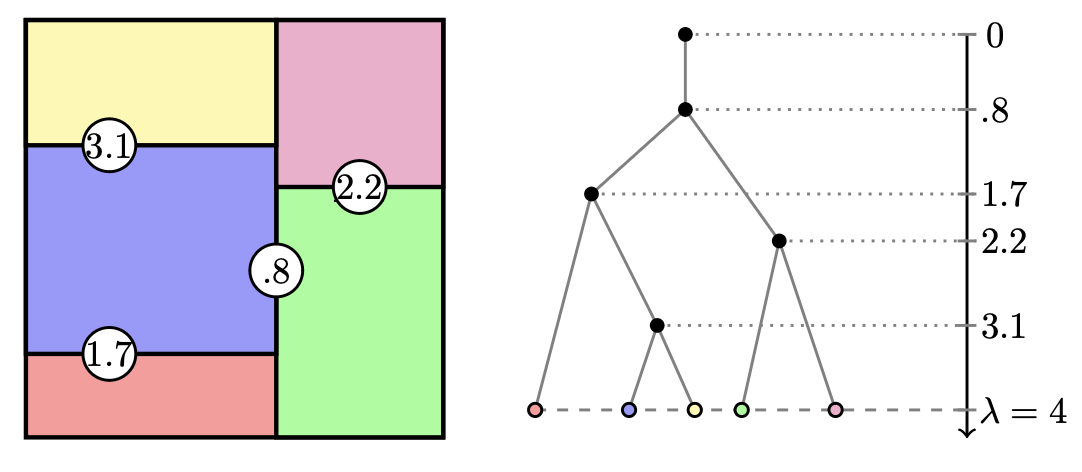
From the Mondrian process to stochastic geometry
The Mondrian process—a recursive partition of space using random axis-aligned hyperplane splits—is used to build random forests with minimax-optimal convergence rates and Laplace kernel approximations. It is also a special case of the stable under iterated tessellation (STIT) process from stochastic geometry, a rich class of stationary hierarchical random tessellations closed under iteration. This connection allows tools from stochastic geometry, such as Palm distributions and the theory of stationary random measures, to be used for the analysis of tree-based machine learning algorithms.
Oblique random forests
Classical Mondrian-based methods use only axis-aligned cuts, which can be statistically suboptimal when the relevant structure in the data lies along oblique directions. We study oblique variants of the Mondrian process in which splits are generated by linear combinations of covariates, corresponding to STIT tessellations driven by non-axis-aligned random hyperplanes. In joint work with Ngoc Mai Tran, we established minimax optimal convergence rates for regression using these oblique random tessellation forests and show that they adapt to intrinsic linear low-dimensional structure in the data.
Dimension reduction
In high-dimensional settings, random tessellation forests can be combined with gradient-based dimension reduction to adaptively learn the directions most relevant for prediction. In joint work with Ricardo Baptista and Yangxinyu Xie, we introduced the TrIM (Transformed Iterative Mondrian) algorithm that iteratively updates a low-dimensional projection alongside the forest, achieving strong empirical performance on high-dimensional regression benchmarks and providing theoretical guarantees under a multi-index model assumption.
Kernel approximations
Random tessellations also provide a flexible family of positive definite kernels. In joint work with Ngoc Mai Tran, we characterize the kernels induced by stationary STIT tessellations, generalizing the result for the Laplace kernel associated with the Mondrian process. We prove uniform convergence rates for kernel approximations based on STIT tessellations and derive a closed-form density estimator from the STIT kernel, giving a new nonparametric estimator with statistical guarantees.