Overview
My research develops geometric frameworks for understanding structured convexity with applications in optimization and statistics. This includes the study of classical objects like zonotopes and polytopes in high-dimensions and generalizations to operator-theoretic settings.
Structured Convex Bodies
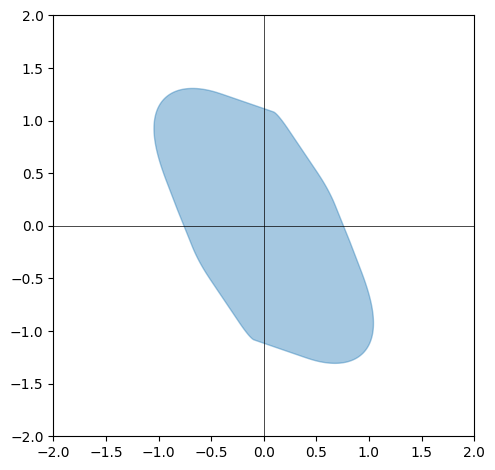
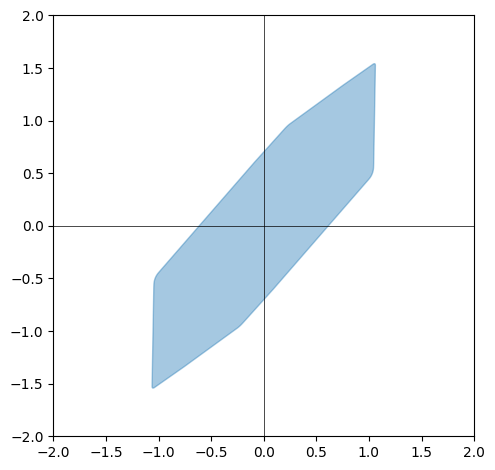
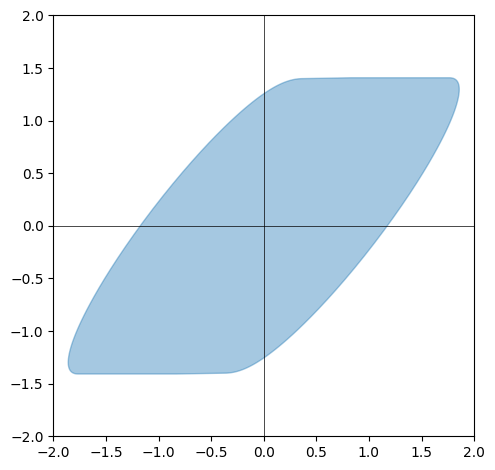
In joint work with Venkat Chandarsekaran, we introduce operatopes, which are Minkowski sums of affine images of operator norm balls—a natural generalization of zonotopes (Minkowski sums of line segments). Taking limits yields operanoids, defined as expectations of random affine images of operator norm balls. These convex bodies generalize limits of zonotopes, called zonoids, which have applications in statistics, stochastic processes, engineering, and the approximation capabilities of neural networks. This work also opens a new asymptotic regimes when the dimension of the matrices become large, leading to the study of noncommutative zonoids using free probability theory.
In joint work with Gilles Bonnet, we study facets of convex hulls of random vectors sampled uniformly from the unit sphere in high dimensions. We establish asymptotic formulas for the height of facets and expected number of facets as dimension grows, identifying different regimes with distinct asymptotic behavior.